We have moved to www.dataGenX.net, Keep Learning with us.

Thursday, October 01, 2015

My Blog Report - till now


First of all, I would like to say thank you all for loving this blog so much. As you are aware we have moved to "www.DataGenX.net" now. Keep Learning, Keep Sharing n Keep loving us :-)

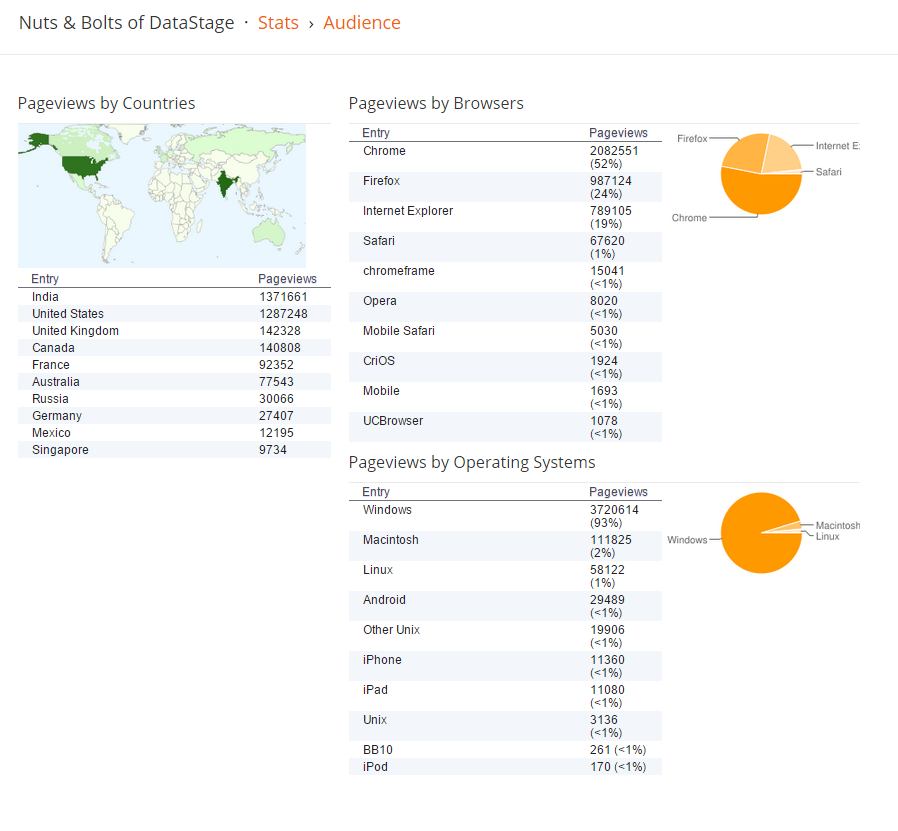
Today I am sharing Blog Report for "Nuts & Bolts of DataStage".


Like the Facebook Page & join Group
https://www.facebook.com/DataStage4you
https://www.facebook.com/groups/DataStage4you

https://twitter.com/datagenx
https://groups.google.com/d/forum/datagenx
For WHATSAPP group , drop a msg to 91-88-00-906098


Tuesday, August 18, 2015

Tuesday, August 04, 2015

Regular Expressions in Linux


What Are Regular Expressions?

A regular expression is a pattern template you define that a Linux utility Uses to filter text. A Linux utility (such as the sed editor or the awk program) matches the regular expression pattern against data as that data flows Into the utility. If the data matches the pattern, it's accepted for processing.

              If the data doesn't match the pattern, it's rejected. The regular expression pattern makes use of wildcard characters to represent one or more characters in the data stream.

Types of regular expressions:
There are two popular regular expression engines:

The POSIX Basic Regular Expression (BRE) engine
The POSIX Extended Regular Expression (ERE) engine

A.     Defining BRE Patterns:
The most basic BRE pattern is matching text characters in a data stream.

Wednesday, July 15, 2015

Error while creating new jobs in DataStage


If you face the error error similar to below can occur when trying to save a newly created job:

Error On CREATE.FILE command
Creating file "RT_CONFIG4817 as type 30, mkdbfile: connot create file
RT_CONFIG4817. Unable to create operating system file "RT_CONFIG4817"

Monday, July 13, 2015

Types of Jobs in DataStage


Server jobs


  • Executed by the DataStage server engine
  • Compiled into Basic
  • Runtime monitoring in DataStage Director
  • No parallel capability

Wednesday, July 08, 2015

What is EPOCH ?


EPOCH is time in seconds since 00:00:00 Coordinated Universal Time (UTC), Thursday, 1 January 1970 ( 1970/01/01 00:00:00 UTC). Or the epoch is Unix time 0 (midnight 1/1/1970), but 'epoch' is often used as a synonym for 'Unix time'. EPOCH time is widely used in every field of IT sector (specially in unix like OS ) where we have to keep difference is generation of something based on time.

Friday, July 03, 2015

Get list of activated tools in Datastage Installation


If we want to check what features have been installed with datastage, we can check it by using LicensingServiceAdmin  tool. This will list down all the tool packs or features including Qualitystage as it comes as a part of datastage.


Tool Location :  {IS_INSTALL_DIR}/ASBServer/bin

Tuesday, June 30, 2015

Maximum number of DataStage Jobs in a project


Filesystems can have a hard limit on number of subdirectories that can be contained in a directory, for example 32766 (32K -2) for Linux

For every job, DataStage will create hash files as subdirectories in the project directory. Here is a list of the subdirectories created for every job. In this list "nn" represents the number (or id) of the job:

DS_TEMPnn
RT_CONFIGnn
RT_STATUSnn
RT_LOGnn
RT_BPnn
RT_BPnn.O
RT_SCnn (only for parallel jobs)

Monday, June 29, 2015

Get nth Highest or Lowest data from Table


Here, we are considering a table student and we need to find out Nth highest and lowest marks of a student.

Nth Highest

select * from student s1 where N-1 = ( select count(distinct(marks)) from student s2 where s1.marks > s2.marks)

Saturday, June 27, 2015

SQL Scenario - 1

You have a table like below :

Name Age Gender
Atul         11 F
Ram 10 F
Disha  6 M
Pavan  8 F
Mani         10 M
Lovely 10 M
Rani    9 M

Unlocking XMETA locks from jobs

How can I unlock an XMETA locked job?

The job cannot be exported and when attempting to open the job, the following error appears:

Unable to open the Job
The Job 'TestJob' is locked by user 'dsadm'
(SessionID '8F1B0326-4F7E-45A8-B8EC-EAA8C4780528')

Do you want to continue and open a read-only view of the Job?
This issue arises when a lock still remains in XMETA for the corresponding job. Information Server will lock the job to ensure that there is no indeterminancy regarding the editing and saving of a job.
The most common causes of this is when a user has closed a client window unexpectedly (e.g. Force Terminate).

Wednesday, June 24, 2015

What happen when Import Sequential File with Extra Column


Job reads sequential file and load into RDBMS table.

What happen if sequential file has extra column in the back of each record?

It depends on data type of last column defined by DS and RDBMS table.
  • If data type of last column = varchar, extra column will be included as last column.

Sunday, June 21, 2015

DataStage Installation Checklist


  • Review the system requirements.
  • learn about tiers and components.
  • Design the topology of your installation.
  • Determine whether to pre-install your database system.
  • Determine whether to pre-install IBM WebSphere Application Server or pre-configure an existing installation of WebSphere Application Server.

Tuesday, June 16, 2015

Friday, June 05, 2015

Thursday, June 04, 2015

Error - mongod shell doesn't start, /data/db doesn't exsist


Error - mongod shell doesn't start, /data/db doesn't exsist


If you face this error while starting MongoDB (mongod), most probably there are 2 reasons for this -

a.  /data/db is not exist at all
b. mongod process don't have access on /data/db

Solution :-


The default db path for mongodb is /data/db/.
So when you run:

Wednesday, June 03, 2015

MongoDB Configuration in Linux


DOWNLOAD the stable version of MongoDB. It will a tar file.

1. Create a folder named 'learn' ( or whatever you want to give )
     $ mkdir -p /learn/mongodb  /app/dbMongo
      # /learn/mongodb  = Holds the MongoDB source
      # /app/dbMongo = Holds the MongoDB database


2. Extract the Mongo DB zip file in /learn folder
  $ tar -xvf MongoDB.tar  /learn/mongodb


3.  change the permission of folder to user who run the db here-  In my case User - atul and Group - atul
  $ chown -R atul:atul  /learn/mongodb  /app/dbMongo


Monday, June 01, 2015

Trigger types in Sequencer Job


While designing Sequencer jobs when we are using any Sequencer Stage ( Job activity, Command activity or others ), it has a tab named 'trigger' which actually determine the actions that occur when the activity runs. Each activity can output different trigger types. 

Three types of triggers are available, with some types having subtypes.
Conditional
A conditional trigger runs the target activity if the source activity fulfills the specified condition. The condition is defined by an expression, and can be one of the following types:

Saturday, May 30, 2015

Data Warehouse Load Methods


A data warehouse is a warehouse that contains data. Sounds funny doesn't it? Imagine a warehouse as a storage structure that may be physical or logical. In the DW it's both...logical as in the data model representation and physical as to the hard disks and other computer equipment that support the data warehouse.

The first question should be "How does the data get there?" Here are three key areas to keep in mind....

Availability - will someone create a report with transactions completed 20 minutes ago or will it be with yesterday's data?

Wednesday, May 27, 2015

Data sources in DataStage


IIS Datastage connectivity options give us a wide scope to connect with different source or targets. It's support RDBMS, ERP, z/OS DB, OLAP system and many more.

Below listed Data Sources are available in IIS v11.3