Showing posts with label DataSet. Show all posts
Showing posts with label DataSet. Show all posts
Friday, November 14, 2014
Linux Shell session setup for DataStage Command Line
To setup Linux Shell for Datastage command line is very important if you are a DataStage Developer and want to work hassle free on DataStage Command Line.
Follow below steps to setup your profile ---
a) First, we will create .dshome file which is containing the path of DS Engine. If you know what it is, good, create a file in root dir with DS Engine path
otherwise execute below scripts to do it by itself
Wednesday, October 22, 2014
DataStage Warning - When deleting data set previous delete attempt not complete
main_program: When deleting data set /full_Path_of_dataset.ds, previous delete attempt not complete; removing /full_Path_of_dataset.ds.being_deleted in order to proceed.
Solution -
This error usually comes when a previous run of respective job got aborted and the auto cleanup process hasn't been completed properly.
Friday, July 18, 2014
Some DataStage Job design
Updating the Master Reports List (MRL) in Datastage
Create a Job which has a Row Generator stage linking to an ODBC or DB2 stage. Change the parameter in the Row Generator stage to output zero records. Write the SQL to update the MRL table as 'After SQL' in the output ODBC or DB2 stage.

Sunday, June 15, 2014
Things need to consider while developing a Datastage job
Datasets
Datasets are the best when storing the results intermediately. Datasets will keep the partitions and sort order if set. This will save re-partitioning, sorting and would make the job more robust.
Performance of the job can be improved if:
1) Unnecessary column are removed from the up and down stream links.
2) Removing these unnecessary columns will help reducing the memory consumption.
3) Always specify the list of columns in the select statement when reading from database. This will not bring unnecessary column data in the job which will save memory and network consumption.
4) Use RCP very carefully.
5) Understand the data-type before using them in the job. Do the data profiling before bringing data in the job.
Tuesday, June 10, 2014
Interview Questions : Unix/Linux : Part-8
1. Display all the files in current directory sorted by size?
ls -l | grep '^-' | awk '{print $5,$9}' |sort -n|awk '{print $2}'
2. Write a command to search for the file 'map' in the current directory?
find -name map -type f
3. How to display the first 10 characters from each line of a file?
cut -c -10 filename
4. Write a command to remove the first number on all lines that start with "@"?
sed '\,^@, s/[0-9][0-9]*//' < filename
ls -l | grep '^-' | awk '{print $5,$9}' |sort -n|awk '{print $2}'
2. Write a command to search for the file 'map' in the current directory?
find -name map -type f
3. How to display the first 10 characters from each line of a file?
cut -c -10 filename
4. Write a command to remove the first number on all lines that start with "@"?
sed '\,^@, s/[0-9][0-9]*//' < filename
Wednesday, June 04, 2014
Surrogate Key Generator - Generate Surrogate Key for Data
In this post, We will see how to generate surrogate key for data, where we have to use surrogate key stage.
A) Design :
Below design is a demo design of job. Here our data source is a row generator which is generating rows. In real time scenario, Source can be a flat file, DB stages, Passive Stage or can be a Active stage also.
In Row Generator Stage, we are generating a col "Name".
.jpg)
Tuesday, June 03, 2014
Surrogate Key Generator - Delete State File
Adding this post as well with Surrogate Key walk through, In this post we will see how to delete a Surrogate Key State file. Its quite simple as creation.
a) Design :
Again, for the deletion of state file, we need only 1 stage in design and that is Surrogate Key Stage.
.jpg)
Saturday, May 31, 2014
Surrogate Key Generator - Create/Update State File
In last post ( Surrogate Key Generator - Create State File ) we have seen how to generate the surrogate key file, In this post we will discuss about what are the other ways to generate it and how to update state file
Update Surrogate State File (Flat File) :-
To update the state file, add a Surrogate Key Generator stage to a job with a single input link from another stage.
.jpg)
Friday, May 30, 2014
Surrogate Key Generator - Create State File
Surrogate keys are numeric keys that can replace business keys in the datawarehouse. A surrogate key has the following characteristics:
1) It is typically an integer.
2) Surrogate keys are unique.
3) Surrogate keys allow you to combine data from tables with incompatible keys.
4) It has no meaning. You will not be able to know the meaning of that row of data based on the surrogate key value.
5) It is not visible to end users. End users should not see a surrogate key in a report.
I will not go in details of surrogate key, I will post it later, But we will see how to generate surrogate keys in DataStage.
Wednesday, May 28, 2014
Some Oracle SQL should known by Developer - 1
========================================================================
Tuesday, May 27, 2014
Interview Questions : DataWareHouse - Part6
What is BUS Schema?
BUS Schema is composed of a master suite of confirmed dimension and standardized definition if facts.
What are the methodologies of Data Warehousing?
Every company has methodology of their own. However, to name a few SDLC Methodology, AIM methodology is standard used.
Monday, May 26, 2014
DataStage Scenario - Design8 - job1
DataStage Scenario Problem --> DataStage Scenario - Problem8
Solution Design :
a) Job Design :
Below is the design which can achieve the output as we needed. Here, we are reading 2 seq file as a input, then data is passing through a Join and Filter stage to achieve the output.
Tuesday, May 20, 2014
Data Warehouse Testing Checklist
Unit testing checklist
A checklist
will aid database programmers to systematically test their code
before formal QA testing.
- Check the mapping of fields that support data staging and in data marts.
- Check for duplication of values generated using sequence generators.
- Check the correctness of surrogate keys that uniquely identify rows of data.
- Check for data-type constraints of the fields present in staging and core levels.
- Check the data loading status and error messages after ETLs (extracts, transformations, loads).
- Look for string columns that are incorrectly left or right trimmed.
- Make sure all tables and specified fields were loaded from source to staging.
- Verify that not-null fields were populated.
- Verify that no data truncation occurred in each field.
- Make sure data types and formats are as specified during database design.
- Make sure there are no duplicate records in target tables.
- Make sure data transformations are correctly based on business rules.
- Verify that numeric fields are populated precisely.
- Make sure every ETL session completed with only planned exceptions.
- Verify all data cleansing, transformation, and error and exception handling.
- Verify stored procedure calculations and data mappings.
Sunday, May 18, 2014
DataStage Scenario - Design7- job1
DataStage Scenario Problem --> DataStage Scenario - Problem7
Solution Design :
a) Job Design : Below is the design which can achieve the output as we needed. Here, we are reading seq file as a input, then data is passing through a Transformer and Peek stage to achieve the output.
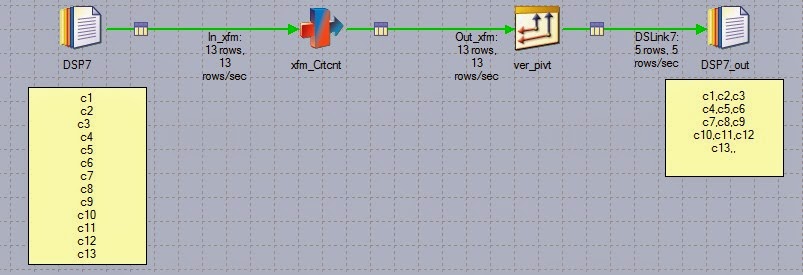
Friday, May 16, 2014
DataStage Scenario - Design6 - job1
DataStage Scenario Problem --> DataStage Scenario - Problem6
Solution Design :
a) Job Design :
Below is the design which can achieve the output as we needed. Here, we are reading seq file as a input, then data is passing through a Transformer stage to achieve the output.

Thursday, May 08, 2014
What ETL is not?
ETL should not be confused with a data creation process. It never creates new data. If a list of hundred employees is being loaded, one more employee cannot be added to the list and make it hundred and one. Or if last name of customer is absent an arbitrary last name cannot be substituted.
Data warehouses are not OLTP systems. Duplication of calculations in Source system & the data warehouse should not be attempted, as the numbers will be very difficult to match during QA. Also in future the process in the source system can change that will result in asynchronous data.
Wednesday, May 07, 2014
Framework ( usually followed ) in ETL Testing
To discuss how testing relates to the different phases of data mart design, this frame-work includes eight phases:
Requirement analysis:
Requirements are elicited from users and represented either informally by means of proper glossaries or formally.Analysis and reconciliation:
Data sources are inspected, normalized, and integrated to obtain a reconciled schema,Monday, May 05, 2014
ETL Testing : Trends & Challenges
ETL Testing : Trends
Count Validation
- Record Count Verification DWH backend/Reporting queries against source and target as a initial check.
Dimensional Validation
Data integrity between the various source tables and relationships. Also we should test the slowly changing dimension as given below. The most common slowly changing dimensions are Types 1, 2, and 3.
Sunday, May 04, 2014
ETL Testing : Approach
Testing is undoubtedly an essential part of DW life-cycle but it received a few attention with respect to other design phases.
DW testing specification:
– Software testing is predominantly focused on program code, while Software testing is predominantly focused on program code, while DW testing is directed at data and information DW testing is directed at data and information. .
– DW testing focuses on the correctness and usefulness of the information delivered to users information delivered to users
– Differently from generic software systems, DW testing involves a huge data volume huge data volume, which significantly impacts performance and productivity.
– DW systems are aimed at supporting any views of data, so the possible number of use scenarios is practically infinite and only few them are known from the beginning.
– It is almost impossible to predict all the possible types of errors that will be encountered in real operational data.
Thursday, May 01, 2014
DataStage Scenario - Problem19
Goal : Reverse duplicate Removal
Input :
source | destination | distance
city1|city2|500
city2|city1|500
city3|city4|500
city4|city3|500
Subscribe to:
Posts
(
Atom
)